1) Bengaluru in one timeline: why the city “moves” differently
Bengaluru’s “mobility culture” didn’t happen overnight—it’s a result of how the city grew.
- 1537: The foundation story. Kempe Gowda I is widely credited with founding the “modern” city core by establishing a fort-town and the Pete market structure that became the city’s trading spine. Wikipedia+1
- A city that kept expanding outward. Cantonment-era growth, public sector industries, and later tech parks created multiple job-centres - not one single downtown - so daily commuting became a lifestyle.
- 2014: Official name change. “Bangalore” officially became Bengaluru (state + central approvals completed; implemented from Nov 1, 2014). Wikipedia+1
Why this matters for vehicles: Bengaluru developed as a “work-cluster city” (Whitefield, ORR, Electronic City, Manyata, etc.). Bengaluru Rural, Bengaluru Urban, Bengaluru South, Bengaluru North, Bengaluru East, Bengaluru West and Bengaluru Central Divisions, BBMP, Greater Bengaluru, Bengaluru Mahanagara Palike, Bengaluru Development Authority.. When homes and offices are far apart, people naturally buy two-wheelers/cars for time certainty.
2) How Bengaluru became India’s IT hub (and why that boosts vehicle sales)
Bengaluru is often called India’s tech capital because of:
- concentration of IT services + product companies,
- deep engineering talent pipeline,
- strong startup ecosystem,
- “Global Capability Centres” scale-up and MNC expansion. Financial Times
Mobility effect:
IT + services create:
- steady monthly income (EMIs become easier),
- high migration (new residents buy vehicles fast),
- shift work (late hours → preference for personal mobility),
- high last-mile needs (autos + cabs + bikes + scooters).
3) Bengaluru’s automobile & manufacturing ecosystem (beyond “IT city”)
Bengaluru is also a major manufacturing belt, supported by industrial zones and supplier networks.
Key clusters
- Bidadi - Ramanagara belt: Major automotive manufacturing presence (Toyota Kirloskar Motor, ancillaries). Toyota publicly lists large installed capacity and long-term investment in the Bidadi area. Toyotabharat+2Toyotabharat+2
- Peenya Industrial Area: Historically one of the largest industrial hubs, with thousands of industries and heavy employment - important for machine tools, auto components, and manufacturing services. The Times of India
- Jigani - Bommasandra - Harohalli - Dabaspet: Large industrial spread facing infrastructure pressure but still housing massive numbers of units and jobs. The Times of India
Why this matters for the used-car + scrappage market:
Manufacturing corridors generate:
- fleet/commercial vehicle demand,
- higher wear-and-tear cycles,
- stronger parts recycling and secondary markets (which must be regulated to avoid illegal dismantling).
4) How many vehicles are registered in Bengaluru till date?
The number is huge - and rising fast.
- Bengaluru’s total registered vehicle population has crossed ~1.2 crore+ by Feb 2025 (reports based on Transport Department data). The Times of India
- Another report notes the total touching ~1.23 crore (and highlights how quickly the city added new vehicles). Deccan Herald
- Category mix is heavily skewed toward two-wheelers, with cars next - exactly what you’d expect in a high-commute city. The Times of India+1
“Which vehicle type sells fastest” in Bengaluru?
Bengaluru’s fastest-growing registrations are typically:
- Two-wheelers (daily commute, affordability, parking ease) The Times of India+1
- Budget cars (often under ₹10 lakh) when prices/incentives align (festive discounts, tax changes, etc.) The Times of India
- Compact/Mid-size SUVs (city + highway mix, family usage) - a strong national trend that also reflects in metro cities.
Note: Brand-wise “Bengaluru-only” leaderboards are not consistently published publicly in an official format. What’s safest is to speak in category terms using Transport Department reporting, and cite national OEM trends only when you label them as India-wide.
5) Which brands/models move faster (realistic view)
What we can say confidently (data-backed)
- Two-wheelers dominate Bengaluru’s vehicle base and new additions. The Times of India+1
- Festive periods can spike registrations sharply (reported daily additions and record monthly registrations). Hindustan Times+1
What’s generally true in Bengaluru’s buyer psyche (market reality)
While exact brand rankings vary by month, Bengaluru tends to reward:
- High mileage + low maintenance (commuters),
- Strong service network (time-sensitive IT workforce),
- Resale value (frequent upgrades),
- EVs for specific users (home charging + predictable routes), while infrastructure gaps still influence adoption. The Times of India
6) Who are the main customer categories buying vehicles in Bengaluru?
Here’s a practical segmentation you can use on your website (sales + marketing + SEO):
- IT/Tech professionals (20s–40s)
- first-time buyers, EMI-driven, preference for reliability + service speed
- Gig economy & last-mile workers (delivery, ride-hailing, on-demand services)
- two-wheelers, high utilization, faster replacement cycles
- Middle-class families in expanding suburbs
- “one car + one/two scooters” pattern; safety + space preference
- SMEs & traders (Peenya/Chickpet/industrial belts)
- goods vehicles, pick-ups, small commercial fleet needs
- Students + early jobbers
- used two-wheelers, budget-led
- Fleet owners & corporate leasing
- structured replacements, compliance-heavy documentation
Scrappage relevance: categories 2, 4, and 6 typically generate more ELVs due to high usage.
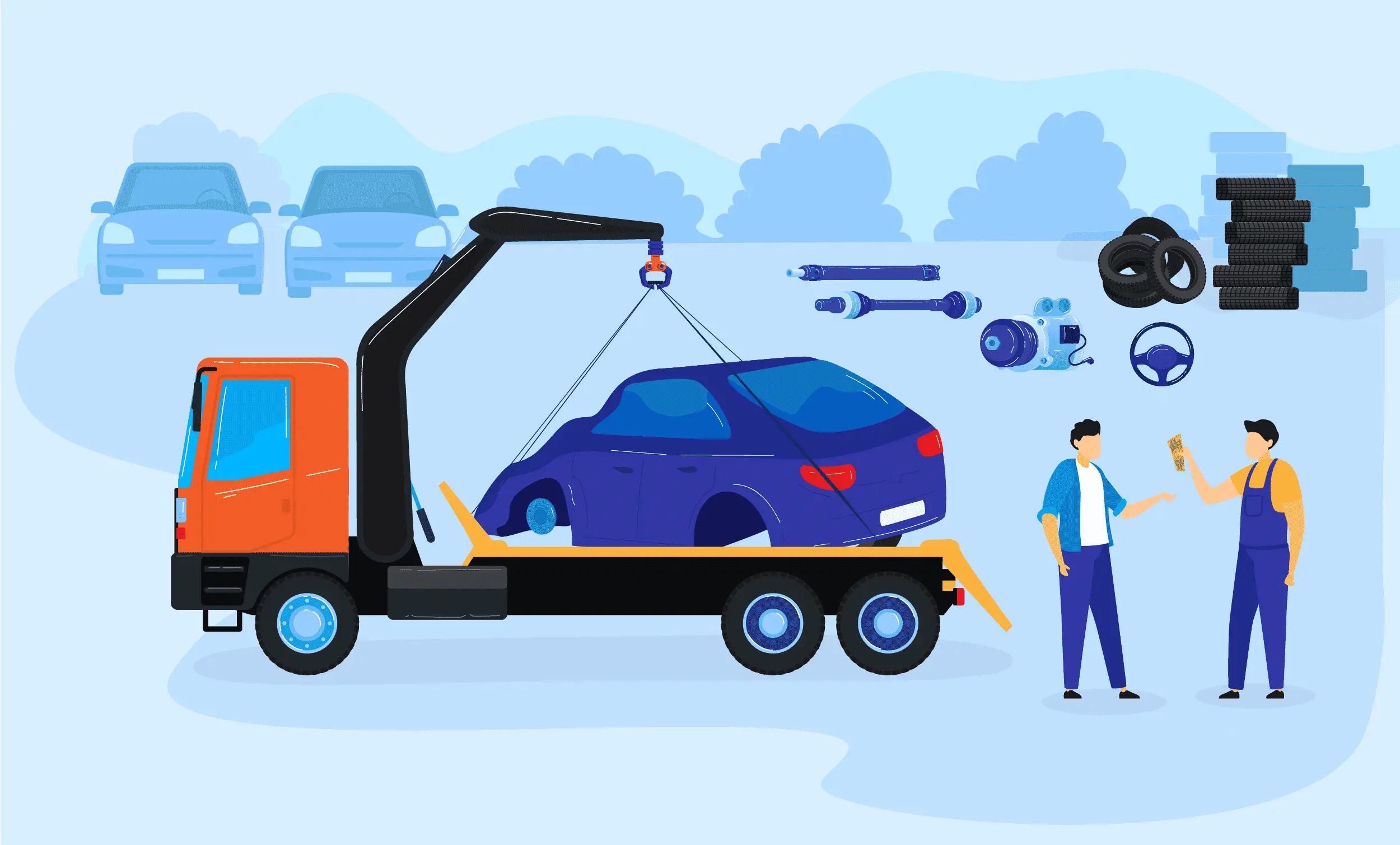
7) Old vehicles, ELVs, and scrappage reality in Karnataka/Bengaluru
Government vehicle scrappage (officially reported)
A recent Karnataka government update reported:
- 18,552 govt vehicles (15+ years, excluding STU buses) had registration cancelled on the Vahan portal (as of Dec 4, 2025).
- 1,493 of these were scrapped at registered scrapping facilities; 17,059 remained to be scrapped. The Indian Express
- Also reported:
- 3,212 old buses scrapped by state transport corporations since April 2023 (with more pending). The Indian Express
Private vehicle scrappage (the gap)
One report flagged that scrappage uptake remains extremely low compared to the eligible population - only a tiny fraction of eligible vehicles are actually scrapped. Bangalore Mirror
What this means:
Bengaluru’s ELV problem is not just “policy” - it’s execution + owner hesitation + paperwork fear + price confusion.
8) What the law actually says (MVI Act / rules) - simplified for owners
Vehicle scrappage is governed through a combination of:
- Motor Vehicles Act, 1988 (registration, permits, compliance),
- Central Motor Vehicles Rules (CMVR) (fitness, testing, documents),
- MoRTH Vehicle Scrappage Policy framework (fitness-driven ELV identification),
- State/UT transport department implementation via Vahan workflows.
The key legal idea owners must understand
Age alone doesn’t “ban” every private vehicle everywhere.
What becomes strict is:
- periodic fitness testing after the threshold age,
- penalties/fees disincentivizing old vehicles,
- and mandatory scrappage if the vehicle is declared End-of-Life (fails fitness / unfit / unsafe).
For government fleets, many states apply stricter retirement rules (as seen in Karnataka’s large-scale scrapping plan). The Indian Express
9) Myths vs facts (Bengaluru ELV + scrappage)
Myth 1: “If my car is 15 years old, it’s automatically illegal.”
Fact: In most cases, it must undergo fitness testing and comply; if it fails or is declared unfit, it becomes ELV.
Myth 2: “Scrapping means I will lose money vs selling in the grey market.”
Fact: Grey-market dismantling often has legal risk (improper RC cancellation, misuse of chassis/parts, environmental violations). Legal scrappage protects you with proper documentation.
Myth 3: “RC cancellation and scrappage are the same.”
Fact: RC cancellation/registration cancellation is a records + compliance outcome; scrappage is the physical dismantling + recycling process done through authorised facilities.
Myth 4: “Any scrapyard can issue scrappage proof.”
Fact: Only authorised/registered scrapping facilities can issue valid proof within the official ecosystem. India lists authorised facilities on the government scrappage portal. vscrap.parivahan.gov.in
10) Where Carbasket fits in (Bengaluru-focused scrapping platform)
Carbasket’s (www.carbasket.in) value in Bengaluru is not just “scrap the vehicle”- it’s making the legal, compliant route easy.
What owners usually struggle with
- confusion about fitness/age rules
- RC status problems (lost RC, hypothecation, owner mismatch, death case, address change)
- fear of vehicle being misused after sale
- unclear scrap valuation
- time cost of running to multiple offices
What Carbasket should position clearly on your page
- Doorstep support + guided documentation
- Channelising dismantling only through authorised scrappage ecosystem vscrap.parivahan.gov.in
- Proof-first approach: ensure owners receive the right scrappage/closure paperwork so the vehicle can’t return to roads illegally
- Transparent scrap value logic: weight, category, recoverable parts, market-linked rates
- Compliance narrative: safety, pollution reduction, circular economy
11) FAQs
1) How many vehicles are registered in Bengaluru till date?
Bengaluru’s registered vehicle population has crossed ~1.2 crore+ (reported around Feb–Apr 2025), driven mainly by two-wheelers and cars. The Times of India+1
2) Which vehicle category sells fastest in Bengaluru?
Two-wheelers lead Bengaluru’s registrations by a wide margin, followed by cars. The Times of India+1
3) How many government vehicles are being scrapped in Karnataka?
Karnataka reported 17,059 government vehicles (15+ years) pending scrappage, with 1,493 already scrapped at registered facilities (as of the cited update). The Indian Express
4) Are old private vehicles (15+ years) banned in Bengaluru?
Not automatically - most cases revolve around fitness certification and compliance. If the vehicle fails fitness or is deemed unsafe, it becomes ELV and should be scrapped legally.
5) How do I verify an authorised scrapping facility?
Use the Government’s authorised scrappage facility listing on the official scrappage portal. vscrap.parivahan.gov.in
6) Why should I use Carbasket instead of a local scrap dealer?
Because legal scrappage protects you from post-sale misuse, supports proper deregistration workflows, and ensures recycling happens through compliant channels.
7) What documents are usually needed to scrap a vehicle in Bengaluru?
Commonly: RC, ID/address proof, vehicle owner KYC, and where applicable - NOC/loan closure for hypothecation, authorisation letter, or legal heir documents (case-specific).
8) Does scrappage help Bengaluru’s pollution and congestion?
Yes - older, poorly maintained vehicles typically emit more and break down more often. Government pushes for fleet retirement reflect this logic. The Indian Express