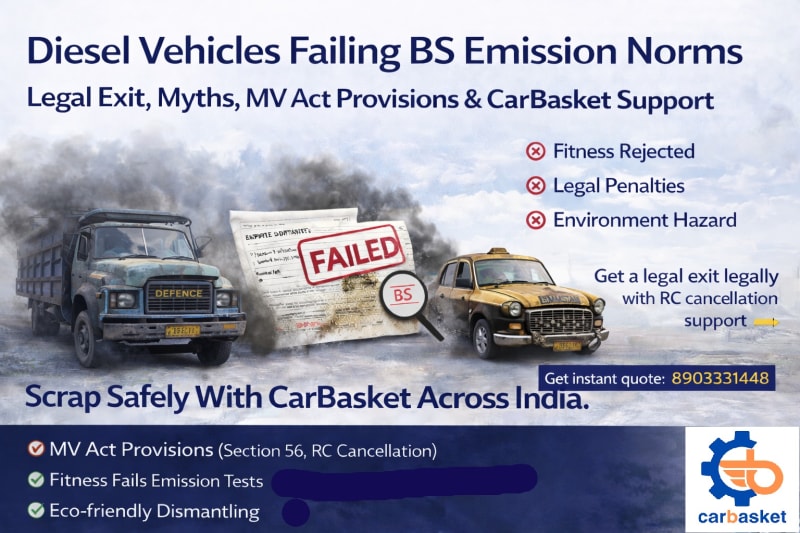
India’s transition from BS-III and BS-IV to BS-VI emission norms has fundamentally changed the future of diesel vehicles. Across cities, highways, and industrial corridors, lakhs of diesel vehicles now fail emission tests, face fitness rejection, or are restricted by court orders and state transport authorities. For many owners, keeping such vehicles has become legally risky, financially draining, and environmentally unsustainable.
This guide explains why diesel vehicles fail BS norms, what the Motor Vehicles Act (MVI Act) says, common myths vs facts, and how Carbasket helps vehicle owners exit legally through RC cancellation support and certified scrapping.
Understanding BS Emission Norms & Diesel Vehicles
What Are Bharat Stage (BS) Norms?
Bharat Stage norms regulate vehicular air pollution in India, similar to Euro norms in Europe.
- BS-III / BS-IV: Older diesel vehicles with higher NOx & particulate emissions
- BS-VI (April 2020 onwards):
- 70–80% reduction in particulate matter
- Advanced emission control (DPF, SCR, EGR systems)
- Ultra-low sulphur diesel (10 ppm)
Most older diesel vehicles were never designed to meet BS-VI, making retrofitting impractical or uneconomical.
Why Diesel Vehicles Fail BS Emission Norms
Diesel vehicles commonly fail due to:
- ❌ Excessive NOx and smoke opacity
- ❌ Failed PUC / emission test
- ❌ Clogged or missing DPF
- ❌ High maintenance cost of SCR systems
- ❌ Poor fuel quality impact on older engines
- ❌ Engine wear after 10–15 years
Once emissions fail, fitness renewal is denied, triggering legal consequences.
Legal Provisions Under the Motor Vehicles Act (MVI Act)
Key Sections & Rules
- Section 56, MV Act - Fitness Certificate mandatory
- Vehicle without valid fitness = illegal to operate
- Rule 62, CMVR - Fitness validity (15 years, then periodic renewal)
- Section 190(2) - Penalty for pollution violations
- NGT & Supreme Court orders
- Diesel vehicles restricted after 10 years in NCR
- State Transport Rules
- BS-IV diesel vehicles increasingly restricted in major cities
👉 If fitness is rejected due to emissions, the vehicle legally becomes End-of-Life (ELV).
What Happens If You Continue Using a Non-Compliant Diesel Vehicle?
- 🚫 Heavy fines & challans
- 🚫 Insurance invalidation
- 🚫 Seizure by enforcement authorities
- 🚫 RC suspension or cancellation
- 🚫 Criminal liability in case of accidents
- 🚫 Environmental penalties
Keeping such vehicles unused is not safe either—liability remains with the RC owner.
Myths vs Facts: Diesel Vehicles & BS Norms
❌ Myth 1: I can keep the vehicle parked forever
✅ Fact: Ownership liability continues until RC cancellation.
❌ Myth 2: Emission failure can always be fixed
✅ Fact: For old diesel vehicles, repair costs exceed vehicle value.
❌ Myth 3: Selling to a local scrap dealer solves the issue
✅ Fact: Without RC cancellation & COD, liability remains.
❌ Myth 4: BS-IV vehicles are always allowed
✅ Fact: Many states now restrict BS-IV diesel vehicles via fitness and permit rules.
Vehicle Scrapping: The Legal Exit for BS-Failed Diesel Vehicles
Once a diesel vehicle:
- Fails emission tests
- Is denied fitness renewal
- Is restricted by law or court orders
👉 Scrapping is the only compliant exit.
What Legal Scrapping Includes:
- Vehicle de-registration
- RC cancellation support in RTO records
- Environment-safe dismantling
- Owner liability closure
How Carbasket Helps Diesel Vehicle Owners
Carbasket provides a compliance-first, pan-India solution for diesel vehicles failing BS norms.
Carbasket Support Includes:
✔ Evaluation of emission & fitness status
✔ ELV eligibility verification
✔ Pickup from home, yard, factory, or police premises
✔ RC cancellation support & RTO coordination
✔ COD issuance (FROM PARTNER FIRM)
✔ Chassis number cut & handover (as proof)
✔ Eco-friendly dismantling via authorized recyclers
Carbasket helps even if:
- RC is old or offline
- Fitness is expired or rejected
- Vehicle is unused or seized
- Owner lacks clarity on BS compliance
Why RC Cancellation Is Critical
Without RC cancellation:
- Future challans may still hit the owner
- Tax & penalty demands can arise
- Legal notices may continue
Carbasket ensures RC cancellation support is completed, protecting owners permanently.
Environmental Impact of Scrapping BS-Failed Diesel Vehicles
- ♻️ Reduces particulate pollution
- ♻️ Prevents illegal resale
- ♻️ Enables metal recycling
- ♻️ Supports India’s clean mobility goals
- ♻️ Aligns with circular economy policies
Final Thought
If your diesel vehicle cannot meet BS emission norms, delaying action only increases legal and financial risk. Carbasket helps you exit responsibly, legally, and permanently-with full documentation and peace of mind.
♻️ Scrap smart. Exit legally. Choose Carbasket.
FAQs - Diesel Vehicles & BS Emission Norms
Q1. Can a BS-III diesel vehicle be used today?
Only in limited areas and subject to fitness; most face restrictions.
Q2. Is retrofitting to BS-VI possible?
Technically rare and financially unviable.
Q3. What if my diesel vehicle fails PUC repeatedly?
It will be marked unfit and cannot legally run.
Q4. Is scrapping mandatory after fitness rejection?
Yes, if fitness is permanently denied.
Q5. Will Carbasket handle RTO formalities?
Yes, including RC cancellation support.