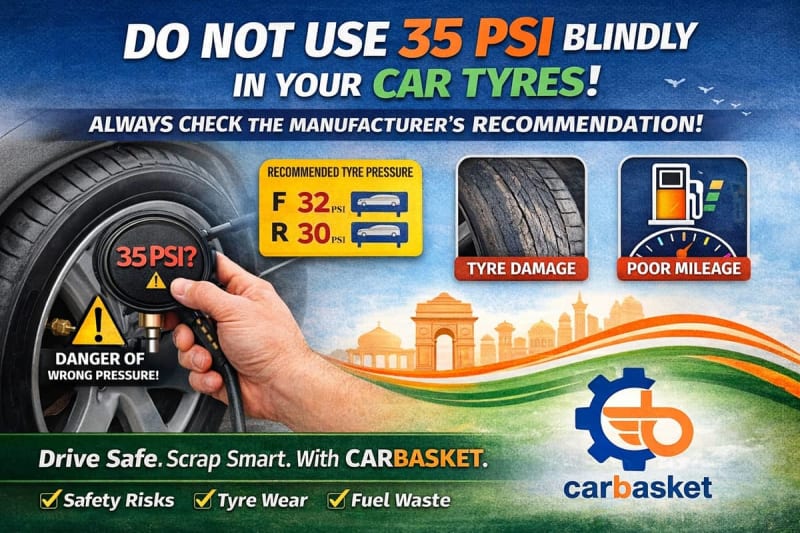
Most Indian car owners have heard one universal advice at fuel stations: “Sir, 35 PSI bhar doon?”
Sounds harmless. Feels professional. But in reality, blindly using 35 PSI can silently damage your tyres, reduce safety, hurt mileage, and even affect suspension life.
This detailed guide explains vehicle air pressure, why manufacturer-recommended tyre pressure matters, and how correct maintenance aligns with Carbasket’s vision of safer, cleaner, and responsible mobility.
What Is Tyre Air Pressure & Why It Matters
Tyre pressure is the amount of air inside your tyre, measured in PSI (Pounds per Square Inch).
It directly impacts:
- Road grip & braking distance
- Ride comfort
- Tyre life
- Fuel efficiency
- Suspension and steering health
Tyres are the only contact point between your car and the road. Even a small mistake in pressure can create big safety risks.
The Biggest Myth: “35 PSI Is Perfect for All Cars” ❌
There is NO universal tyre pressure.
Every vehicle is engineered differently based on:
- Vehicle weight
- Tyre size & profile
- Suspension tuning
- Load distribution (front vs rear)
Using the same pressure for a hatchback, sedan, SUV, or EV is technically wrong and unsafe.
Where to Find the Correct Tyre Pressure for Your Car ✅
Always follow the Manufacturer Recommendation Sticker, usually located:
- Inside the driver-side door frame
- Inside fuel lid
- In the owner’s manual
This sticker clearly mentions:
- Front tyre pressure
- Rear tyre pressure
- Pressure for normal load vs full load
👉 That sticker is your tyre Bible. Not the fuel station guy.
What Happens If You Overinflate Tyres (Too Much PSI)
Many people think higher PSI = better mileage. Partly true, but dangerous.
Risks of Overinflation:
- Reduced tyre contact patch
- Poor braking, especially on wet roads
- Harsh ride & vibration
- Faster centre tyre wear
- Higher risk of tyre burst at highway speeds
A tyre burst at 100 km/h is not a mileage problem — it’s a life-threatening risk.
What Happens If You Underinflate Tyres (Low PSI)
Underinflation is equally harmful.
Risks of Underinflation:
- Increased rolling resistance
- Poor fuel efficiency
- Excessive shoulder wear
- Overheating of tyre walls
- Heavy steering & unstable handling
Underinflated tyres silently age faster, pushing vehicles towards early scrappage.
Different Cars, Different Pressure Requirements
Vehicle TypeTypical PSI RangeHatchback28–32 PSISedan30–34 PSICompact SUV32–36 PSIFull-size SUV34–40 PSIElectric Vehicles36–42 PSI
⚠️ These are indicative only. Always trust the sticker.
Cold Tyre Pressure vs Hot Tyre Pressure
Manufacturers specify cold tyre pressure:
- Check before driving
- Or after the car is parked for 3+ hours
Driving heats the air inside tyres, increasing PSI by 2–4 units. Never deflate hot tyres blindly.
How Incorrect Tyre Pressure Leads to Early Vehicle Scrapping
Poor tyre maintenance causes:
- Suspension damage
- Steering rack wear
- Uneven chassis stress
- Increased emissions
Over time, these issues make vehicles:
- Unsafe
- Costly to repair
- Unfit in fitness tests
This is where Carbasket Vehicle Scrapping plays a crucial role ♻️.
Carbasket’s Role in Responsible Mobility ♻️
At Carbasket Automobile Services India Pvt. Ltd., we believe:
Responsible driving includes responsible maintenance - and responsible retirement.
We support:
- Vehicle scrapping
- Environment-friendly recycling
- Legal RC cancellation support
- Circular economy in the automobile sector
Correct tyre pressure extends vehicle life. Responsible scrapping protects lives and the environment.
Both are equally important.
FAQs - Vehicle Tyre Air Pressure
Q1. Is 35 PSI good for all cars?
No. Tyre pressure varies by vehicle model, load, and tyre size. Always follow manufacturer recommendation.
Q2. Where can I find my car’s tyre pressure sticker?
Inside driver door frame, fuel lid, or owner’s manual.
Q3. Should front and rear tyre pressure be same?
Not always. Many cars require different front and rear PSI due to weight distribution.
Q4. Does higher tyre pressure improve mileage?
Slightly, but it reduces safety, comfort, and tyre life if overinflated.
Q5. How often should tyre pressure be checked?
At least once every 2 weeks and before long trips.
Q6. Can wrong tyre pressure cause vehicle rejection in fitness test?
Yes. Uneven tyre wear and suspension issues can impact fitness results.
Q7. When should I consider vehicle scrapping?
If repair costs exceed value, vehicle fails fitness test, or becomes unsafe — Carbasket can help.
Final Words
Next time someone says “35 PSI bhar doon?” - pause.
Look at the sticker. Protect your tyres. Protect your life.
And when a vehicle reaches the end of its safe journey, Scrap it responsibly with Carbasket 🇮🇳♻️