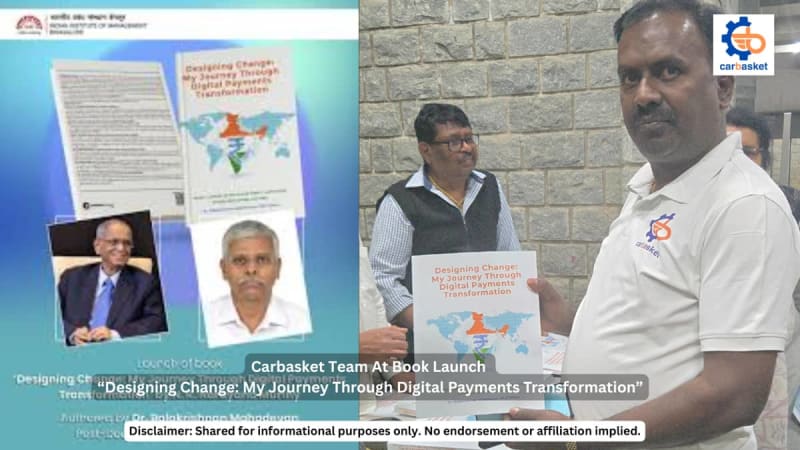
India’s digital payments transformation is often discussed through apps, platforms, and numbers. But at the book launch of Designing Change: My Journey Through Digital Payments Transformation at Indian Institute of Management Bangalore, the conversation went deeper — into policy thinking, institutional discipline, and long-term vision.
At this event, R. Gandhi, Former Deputy Governor of the Reserve Bank of India, shared his reflections on India’s payments evolution, drawing from decades of experience inside the country’s financial regulatory system.
The book launch, organised by IIM Bangalore’s Centre for Digital Public Goods, brought together policymakers, technologists, academics, and industry leaders. The chief guest for the evening was N. R. Narayana Murthy, adding further gravitas to the discussion on institutional change and nation-building.
Why R. Gandhi’s Perspective Matters
R. Gandhi served as RBI Deputy Governor between 2014 and 2017 — a period when India’s financial ecosystem was undergoing foundational change. His responsibilities included payment and settlement systems, currency management, banking technology, and financial infrastructure.
This makes his commentary on Designing Change especially significant. Rather than viewing digital payments as a sudden fintech success, Gandhi positioned them as the outcome of sustained regulatory foresight, governance frameworks, and incremental reforms carried out over decades.
His remarks reinforced a critical truth:
India’s digital payments success is not accidental — it is institutional.
Payments as Public Infrastructure, Not Just Technology
One of the key themes highlighted by R. Gandhi was that payment systems are public infrastructure, similar to roads or power grids.
According to him:
- Technology enables speed and scale
- Policy ensures fairness and inclusion
- Regulation builds trust and systemic stability
He emphasised that without clear rules, interoperability standards, and risk oversight, even the most advanced technology can fail at scale. This layered approach — policy first, platform next, adoption last — has been central to India’s payments architecture.
This perspective aligns closely with the journey documented in the book by Balakrishnan Mahadevan, which chronicles how India quietly built the rails before the world noticed the traffic.
Lessons from India’s Payments Evolution
During his address, R. Gandhi reflected on several lessons that are relevant not just to banking, but to all large-scale digital transformations:
1. Incremental Reform Beats Disruptive Shock
India’s systems evolved step by step — RTGS, NEFT, IMPS, and later UPI. Each layer prepared the ecosystem for the next.
2. Governance Enables Innovation
Fintech innovation flourishes when rules are predictable. Regulatory clarity allowed banks, startups, and consumers to adopt digital payments with confidence.
3. Trust Is the Real Currency
User trust — in banks, regulators, and systems — is what ultimately drives adoption. Without trust, scale collapses.
These insights resonate strongly in today’s conversations around AI, digital public infrastructure, and platform governance.
Relevance Beyond Banking
What made R. Gandhi’s remarks particularly compelling was their cross-industry relevance. His reflections apply equally to:
- Mobility platforms
- Environmental and sustainability systems
- Formalisation of informal sectors
- Circular economy and asset lifecycle management
The message was clear: systems that impact millions must be built responsibly, not rushed recklessly.
Why This Matters to Carbasket
At Carbasket, we operate at the intersection of regulation, technology, and environmental responsibility. India’s vehicle scrappage ecosystem — much like digital payments — depends on:
- Clear policy frameworks
- Transparent processes
- Trust between citizens, businesses, and regulators
Listening to leaders like R. Gandhi reinforces our belief that organized, compliant, and technology-enabled systems are the only sustainable way forward.
Conclusion
The IIM Bangalore book launch of Designing Change was more than a literary event. It was a reminder that India’s biggest digital successes are rooted in institutional patience, regulatory wisdom, and long-term thinking.
R. Gandhi’s reflections offered a rare insider’s view into how thoughtful governance can quietly shape national transformation — a lesson that remains deeply relevant as India builds its next generation of digital and environmental infrastructure.
Building India’s Next Responsible System — Together
At Carbasket, we are committed to building a transparent, compliant, and environmentally responsible vehicle scrapping ecosystem — aligned with India’s regulatory vision and sustainability goals.
♻️ If you’re an individual, fleet owner, or institution looking to scrap vehicles responsibly
📍 If you value compliance, documentation, and environmental impact
🚗 If you believe India’s systems must be built the right way
Connect with Carbasket today and be part of India’s organised automobile recycling movement.
👉 Because real change is not just designed — it is implemented responsibly.
Disclaimer: This article is for informational purposes only. Images are used editorially and do not imply endorsement.