Many vehicle owners in India believe that once a vehicle becomes old, unused, or scrapped, its registration automatically gets cancelled.
This assumption is partly true-but mostly misleading.
In reality, vehicle de-registration in India is not always automatic. Whether it happens automatically or requires owner action depends on how, where, and why the vehicle exits the system.
Understanding this distinction is critical to avoid:
- Legal liability
- Traffic challans
- Misuse of your old vehicle
- Ownership disputes
What Is Vehicle De-Registration?
Vehicle de-registration is the official removal of a vehicle’s registration number from the VAHAN / RTO database.
Once de-registered:
- The vehicle legally ceases to exist on Indian roads
- Ownership responsibility ends
- The vehicle cannot be sold, transferred, or reused
- The registration number becomes invalid permanently
Is De-Registration Automatic in India?
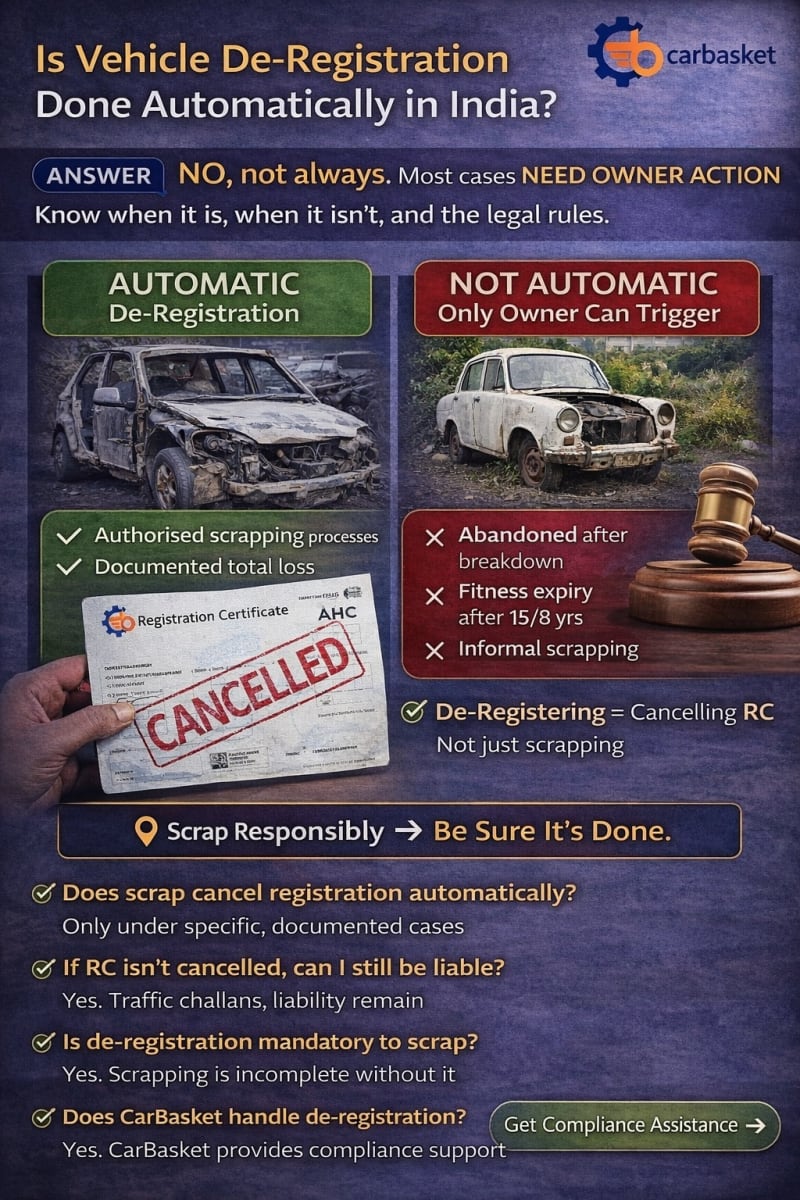
Short Answer: No, not always.
Vehicle de-registration is automatic only in limited, specific scenarios.
In most cases, owner involvement or formal scrapping documentation is required.
Let’s break it down clearly.
Cases Where De-Registration Happens Automatically
1. Authorised Vehicle Scrapping (Under Scrappage Policy)
When a vehicle is scrapped through an authorised scrapping ecosystem, de-registration can happen automatically after proper documentation is generated.
This includes:
- Vehicle scrapped through recognised channels
- Scrapping certificate issued
- Data synced with VAHAN
⚠️ Automatic does not mean “without process”—it means system-triggered after compliance.
2. Vehicles Declared Total Loss by Insurance (In Some States)
In cases of:
- Severe accident
- Fire or flood damage
- Insurance declared “total loss”
Some RTOs initiate de-registration after receiving official insurer confirmation.
However, this is not uniform across India.
3. Government-Seized or Condemned Vehicles
Vehicles:
- Seized permanently
- Declared unfit by authorities
- Condemned fleets (government vehicles)
may be de-registered automatically by the department.
Cases Where De-Registration Is NOT Automatic
1. Abandoned Vehicles
Simply abandoning a vehicle does not trigger de-registration.
The vehicle:
- Remains in your name
- Continues to attract legal risk
- Can be misused
2. Fitness Expiry (15 Years / 8 Years)
Fitness expiry does not cancel registration automatically.
Even after:
- 15 years (private vehicle)
- 8 years (commercial vehicle)
The RC remains active until formally cancelled.
3. Non-Running or Parked Vehicles
A vehicle that:
- Is not running
- Is parked for years
- Is unused
is still legally registered.
4. Informal Scrapping or Local Scrap Dealers
Vehicles scrapped outside authorised processes:
- Do not trigger automatic de-registration
- Often lead to RC misuse
- Leave owners legally exposed
Why Automatic De-Registration Is a Dangerous Assumption
Many owners assume:
“Once scrapped, the RTO will take care of it.”
This assumption causes:
- Traffic challans years later
- Criminal cases linked to old RC
- Ownership disputes
- Insurance complications
De-registration is about data closure, not just physical disposal.
Legal Position Under the Motor Vehicles Act
Under the Motor Vehicles Act, 1988 and Central Motor Vehicle Rules (CMVR):
- A vehicle remains valid until officially removed from records
- Fitness expiry does not equal deregistration
- Scrapping must be documented
- RC cancellation is mandatory for permanent removal
The National Vehicle Scrappage Policy strengthens this requirement.
How Carbasket Ensures Proper De-Registration
Carbasket is built around compliance-first scrapping, not informal disposal.
What Carbasket Does:
- Ensures vehicles go through structured scrapping
- Guides owners on documentation requirements
- Helps ensure RC closure post-scrapping
- Prevents illegal reuse or resale
- Protects owners from future liability
👉 The goal is legal closure, not just pickup.
Common Myths About Automatic De-Registration
❌ “Fitness expiry cancels RC automatically”
❌ “Scrap dealers handle deregistration”
❌ “Non-running vehicles are auto-cancelled”
❌ “Old vehicles are removed from records by default”
✔️ Only verified, documented processes trigger de-registration
How to Ensure Your Vehicle Is Properly De-Registered
To be safe:
- Scrap only through recognised channels
- Declare vehicle condition honestly
- Ensure scrapping documentation exists
- Follow RC cancellation steps
- Keep records for future reference
Carbasket helps owners understand and follow these steps correctly.
FAQs – Automatic Vehicle De-Registration in India
Is vehicle de-registration automatic after scrapping?
Only when scrapping is done through authorised processes and records are updated in VAHAN.
Does RC expire automatically after 15 years?
No. Fitness expires, not registration.
Can abandoned vehicles be auto de-registered?
No. Abandonment does not remove ownership.
Is de-registration mandatory for scrapping?
Yes. Scrapping is incomplete without RC cancellation.
Does Carbasket handle de-registration?
Carbasket provides guidance and compliance support as part of responsible scrapping.
What happens if de-registration is not done?
The owner remains legally responsible for the vehicle indefinitely.