1. The Incident: What Happened at Yelahanka RTO?
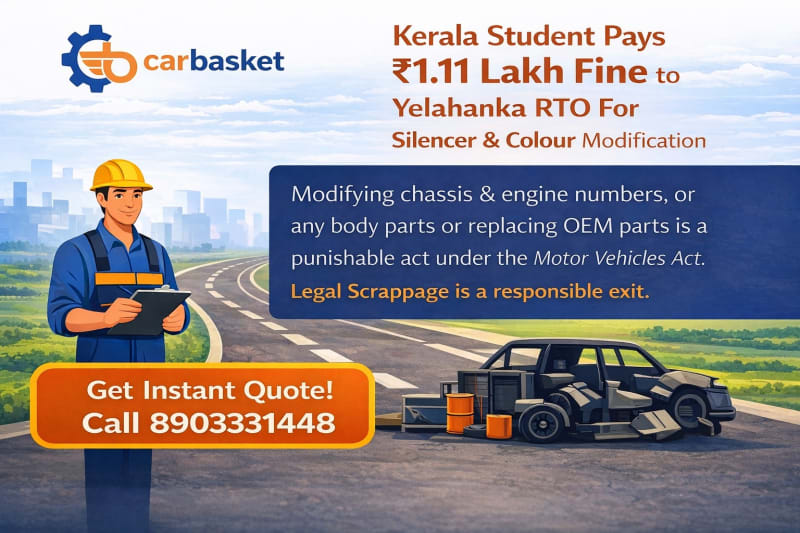
Earlier this month, a student from Kerala, studying in Bengaluru, was fined ₹1.11 lakh by the Yelahanka Regional Transport Office (RTO) for multiple violations of the Motor Vehicles Act (MVA).
Violations reportedly included:
- Modified exhaust/silencer
- Repainting the vehicle without RTO approval
- Tampering with chassis plate and engine number
- Non-OEM body modifications
This case has gone viral not because the fine is rare - but because many vehicle owners unknowingly commit the same violations, assuming modifications are “normal” or “harmless”.
2. Why This Case Is Important (Especially for Students & Out-of-State Owners)
This incident highlights a crucial reality:
Your vehicle must comply with Indian law, not social media trends.
For students and young owners:
- Vehicles registered in Kerala but driven in Karnataka are fully subject to Karnataka RTO enforcement
- “It’s just cosmetic” is not a legal defence
- Police checks increasingly include chassis & engine verification
3. What the Law Actually Says (Motor Vehicles Act - Explained Simply)
A. Modified Silencer / Exhaust System
- Any change that alters noise or emission levels is illegal
- Only OEM-approved exhaust systems are permitted
👉 Modified silencers are treated as:
- Noise pollution
- Emission violation
- Safety risk
B. Repainting or Changing Vehicle Colour
- Vehicle colour is recorded in the Registration Certificate (RC)
- Changing colour without RTO approval is illegal
Required process (if legal change intended):
- Apply to RTO
- Get approval
- Update RC
Skipping this = violation.
C. Tampering with Chassis Number or Engine Number (Most Serious Offence)
This is treated as a major criminal offence.
Why?
- Chassis & engine numbers are the identity of the vehicle
- Used to detect:
- stolen vehicles
- accident write-offs
- illegal resale
Altering, defacing, or replacing these numbers can lead to:
- Heavy fines
- Vehicle seizure
- Criminal proceedings
D. Non-OEM Body Parts & Structural Changes
Illegal modifications include:
- Aftermarket body kits affecting structure
- Non-OEM bumpers, lights, frames
- Alterations affecting dimensions or safety
Unless explicitly approved and endorsed by RTO, these are punishable.
4. Why Penalties Are Becoming Heavier in India
India is moving towards:
- Stricter enforcement
- Digital RC & Vahan database checks
- Automated number & identity verification
- Inter-state data sharing
So even if a modification was ignored earlier, it may now be detected instantly.
The ₹1.11 lakh fine reflects:
- Multiple violations combined
- Zero-tolerance approach to tampering
5. Myths vs Facts (Critical Section)
Myth 1: “Only silencer change is illegal, colour change is fine”
Fact: Both are illegal without approval.
Myth 2: “If it’s a private vehicle, rules are relaxed”
Fact: Law applies equally to private and commercial vehicles.
Myth 3: “Kerala vehicle won’t be checked in Karnataka”
Fact: RTOs enforce rules regardless of state registration.
Myth 4: “Everyone modifies vehicles, so it’s okay”
Fact: Enforcement is selective, not permission.
6. What Options Does a Vehicle Owner Have If the Car Is Heavily Modified?
When a vehicle:
- has multiple illegal modifications,
- fails compliance checks,
- risks repeated fines or seizure,
Restoration to OEM condition may cost more than the vehicle’s value.
At this stage, owners usually face two choices:
- Spend heavily to restore & regularise
- Exit the vehicle legally through scrappage
7. Role of Carbasket: A Legal Exit When Compliance Becomes Impossible
Carbasket helps vehicle owners who are:
- stuck with non-compliant vehicles
- facing repeated RTO issues
- unsure how to legally dispose of such vehicles
How Carbasket Helps:
- Evaluates if the vehicle is economically repairable or better scrapped
- Guides owners through legal vehicle scrappage
- Prevents:
- misuse of vehicle identity
- future challans
- legal liability
- Ensures the vehicle does not return to roads illegally
Scrapping is not failure - it is responsible closure.
8. Why This Matters for Students & Young Vehicle Owners
Students often:
- buy used or modified vehicles cheaply
- inherit previous owner’s illegal changes
- assume “I didn’t do it, so I’m safe”
Legally, the current owner is fully responsible.
This Yelahanka case is a warning:
Ignorance is expensive. Compliance is cheaper.
9. FAQs
Q1. Is vehicle modification illegal in India?
Yes, unless specifically approved and endorsed by the RTO.
Q2. Can I change my car silencer?
Only OEM-approved silencers are legal. Aftermarket loud silencers are illegal.
Q3. Is repainting a car without RTO permission illegal?
Yes. Colour change must be approved and updated in RC.
Q4. What if chassis or engine number is altered?
It is a serious offence and can lead to seizure and criminal action.
Q5. What if restoring the car is too expensive?
Legal vehicle scrappage is a safe and compliant option.
Q6. How does Carbasket help in such cases?
Carbasket provides a legal scrappage pathway, preventing future liability and misuse.
Final Takeaway
The ₹1.11 lakh fine imposed by Yelahanka RTO is not an isolated incident - it reflects India’s tightening stance on illegal vehicle modifications.
For students, young owners, and interstate vehicle users:
- Style cannot override law
- Modifications can destroy resale value
- Non-compliance can cost more than the car itself
When compliance is no longer practical, responsible scrappage through Carbasket becomes the smartest choice.