1) Kolkata in one story: why this city feels “older”, denser, and always moving
Kolkata isn’t just another metro - it is a port-city + former imperial capital + cultural capital, built along the Hooghly (Hugli) River, and shaped by trade, administration, and migration.
- Kolkata served as the capital of British India (1772–1911).
- The official English name Calcutta changed to Kolkata in 2001, aligning with Bengali pronunciation.
Why this matters for mobility:
Old neighbourhoods, narrow roads, heavy markets, a river-banked core, and constant inflow from the wider metro region create a city where road space is limited but travel demand keeps rising.
2) Kolkata “divisions” (how the city is administratively structured)
If you’re writing a location-focused scrappage page, Kolkata’s civic divisions help you build “trust + local relevance”.
Kolkata Municipal Corporation (KMC)
- 144 wards grouped into 16 boroughs (KMC’s administrative structure).
How you should use this for to:
- Borough/ward clusters
- Major localities (North Kolkata, Central, South, East/Kasba, Salt Lake fringe, Behala belt)
- RTO catchments (explained later)
3) What Kolkata is famous for
Kolkata is widely known for:
- Heritage & culture (literature, theatre, “para” culture, Durga Puja)
- Port and trade (river/port logistics)
- Education and institutions
- A unique mix of old city fabric + modern business districts
Mobility outcome:
A city with strong commerce + dense neighbourhood living tends to generate:
- heavy two-wheeler and small-car usage,
- high taxi/auto movement,
- frequent stop-go traffic,
- faster ageing of vehicles (clutch, suspension, engine wear).
4) Kolkata’s automobile market: what sells fast
A) The fastest-moving category: personal vehicles (especially 2-wheelers + small cars)
Recent registration stories from Kolkata show rising preference for personal vehicles, linked to convenience and public transport perception.
B) City-specific reality: road space is tight → compact wins
Kolkata’s roads and parking constraints naturally favour:
- two-wheelers
- hatchbacks / compact sedans
- compact SUVs (rising trend but still “space sensitive”)
Brand talk (safe way to write it)
City-level “brand #1” claims change monthly and aren’t always published as official Kolkata-only rankings. A safer, high-conversion way is to write:
“Kolkata buyers typically prefer brands with:
- strong service coverage,
- high fuel efficiency,
- easy spare availability,
- better resale demand (because upgrades are frequent).”
5) Who buys vehicles in Kolkata?
Use these personas for content + lead targeting:
- Office-goers & salaried households
- buy small cars / scooters for predictability and safety
- Small business owners, traders, and market-linked jobs
- high daily usage; prefer low maintenance
- Gig economy workers (delivery, ride services)
- two-wheelers dominate; faster replacement → more ELVs over time
- Fleet and commercial operators
- taxis, goods carriers, last-mile logistics (age + compliance pressure is higher)
- Family buyers upgrading from 2-wheeler to first car
- prefer compact, reliable, budget-friendly models
6) How many vehicles are registered in Kolkata “till date”?
Public sources provide strong baselines and growth signals, even if “live total till today” changes daily.
A) Official dataset baseline (as of 31 March 2020)
India’s Open Government Data platform has city-wise datasets from the Road Transport Year Book for registered motor vehicles in million-plus cities (Transport and Non-Transport) as on 31.3.2020.
B) City-level composition snapshot (2020)
A city-series dataset (commercial source compiling official statistics) reports for Kolkata (2020):
- non-transport cars and two-wheelers in lakhs (unit-thousands series), and transport vehicles as well.
C) Current growth signal (recent registrations)
- 8,496 new vehicles registered in July 2025 (RTO-wise reporting: Beltala WB-01–WB-04, Kasba WB-05–WB-06, Salt Lake WB-07–WB-08, Behala).
- A separate report notes 16,975 new vehicles registered in Jan–Feb across four regional transport offices.
What this means: Even without quoting an ever-changing “today total”, Kolkata is clearly adding thousands of new vehicles monthly, which directly increases:
- congestion,
- parking stress,
- vehicle density,
- emissions load.
7) Vehicle density in Kolkata (why traffic feels heavier than other metros)
A reported metric widely cited in Kolkata discussions:
- 2,448 vehicles per kilometre of road (reported as the highest vehicular density among Indian metros, based on state transport department + Kolkata Police data).
This single statistic is powerful for your blog because it explains:
- why even small breakdowns cause jams,
- why old vehicles become a larger risk (stalling, smoke, leaks),
- why scrappage is not just “environment”—it’s urban mobility.
8) Pollution in Kolkata: CAIQ / AQI explained (and why winter spikes)
AQI / “CAIQ” in practical terms
In India, cities commonly use AQI (Air Quality Index) as a public-facing measure. Kolkata has multiple monitoring stations (e.g., Rabindra Sarobar, Ballygunge, Jadavpur, RBU, etc.) published through systems tied to CPCB/WBPCB monitoring.
What Kolkata’s AQI looks like on bad days (winter pattern)
- Reports show Kolkata’s AQI often ranges from moderate to poor, with some areas spiking higher (examples include Ballygunge and Jadavpur having higher readings; Rabindra Sarobar often relatively better due to greenery/water body influence).
Why vehicle scrappage matters to Kolkata’s air
Kolkata’s pollution isn’t from vehicles alone (construction dust, regional smoke, weather inversion), but vehicular emissions are a consistent daily contributor, especially in stop-go conditions.
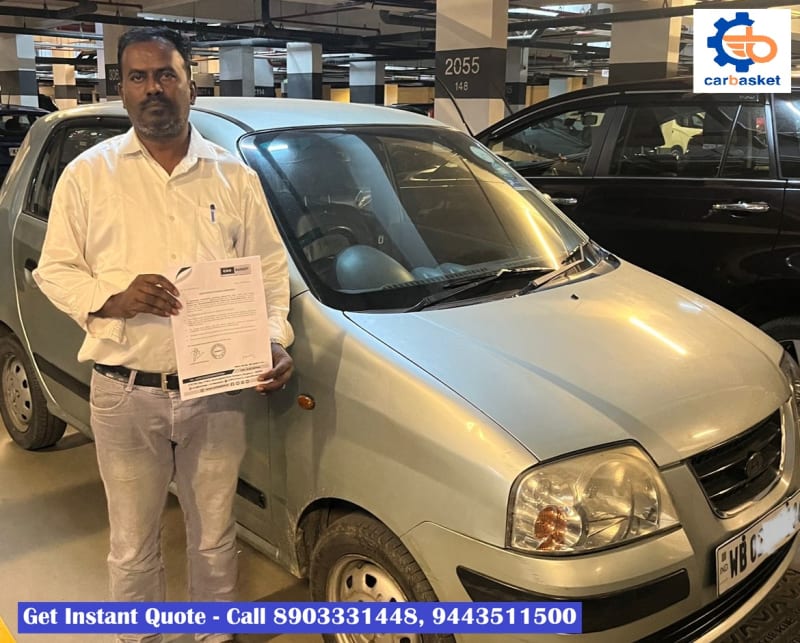
9) Real customer story: Carbasket scrapped a 2006 Hyundai Santro in Kolkata
The vehicle
Hyundai Santro, Santro ZIp / Santro Xing (2006) - a classic Kolkata-friendly car:
- Compact footprint (easy in dense lanes)
- Practical hatchback design
- Commonly seen in Indian cities for years
Model context (reliable public references):
- Santro nameplate production in India’s first era spans 1998 - 2015 (with “Santro Xing” used for the facelifted period).
- Santro Xing variant listings show 1086 cc petrol and multiple trims in the 2003–2008 generation band, relevant to a 2006 vehicle.
Why this 2006 Santro became an ELV candidate (typical reasons)
For a 2006 petrol hatchback, owners in metros often face:
- rising repair costs (suspension, steering rack, AC, wiring)
- emission compliance worries
- insurance value mismatch vs repair spend
- “vehicle downtime” becoming costlier than replacement
What Carbasket did (your platform story)
Step-by-step scrappage journey (publish-ready):
- Vehicle details captured (RC status, year, fuel, location, condition photos)
- Legal path explained (registration cancellation workflow + compliance)
- Pickup coordination (doorstep convenience)
- Scrappage routed through formal ecosystem (not informal dismantling)
- Documentation closure guidance so the vehicle doesn’t re-enter circulation
You can add your internal operational details here (pickup time, locality, customer quote, scrap valuation method) to make the story feel 100% real.
10) Scrappage in West Bengal: government push + private reality
A) Commercial vehicles >15 years: state action
West Bengal has initiated scrappage processes for commercial transport vehicles aged over 15 years in Kolkata and Howrah (reported).
B) RC cancellation simplification (important!)
West Bengal introduced an order to simplify cancellation of old vehicle registrations (scrapped/lost/unusable) and aligned changes with VAHAN workflows, including tax recovery up to cancellation date and requiring an indemnity bond.
C) Private scrappage numbers (why city-wise totals are hard to find)
Private ELV scrappage counts are often not available as a single clean public “Kolkata total”. That gap is exactly where Carbasket can lead by building:
- a structured city intake funnel (data capture)
- transparent eligibility + document flows
- compliance-first execution
11) The law: MVI Act provisions owners should understand (simple, accurate)
Section 55 - Cancellation of registration
The Motor Vehicles Act includes Section 55 (Cancellation of registration), covering cases where a vehicle is destroyed, permanently incapable of use, lost, etc., and how registering authority handles cancellation.
Section 56 - Fitness certificate (especially transport vehicles)
Section 56 explains that a transport vehicle isn’t treated as validly registered unless it carries a valid fitness certificate (and references authorised testing station frameworks).
The formal scrappage ecosystem
India’s scrappage ecosystem is supported by:
- rules/notifications and portal workflows,
- the VAHAN-linked scrappage systems and user manuals.
- A recent government release also describes the goal of the scrappage policy: reduce pollution from old/unfit vehicles via scientific scrapping and integrate informal sector into formal ecosystem.
12) Myths vs facts (Kolkata edition)
Myth: “If I scrap my car, it’s just a metal sale.”
Fact: In cities like Kolkata, the bigger value is legal closure - preventing future misuse, challans, or ownership disputes.
Myth: “Old car can be sold anywhere, responsibility ends.”
Fact: Without proper record closure, liability can trace back. West Bengal’s updated cancellation process highlights why clearing “scrapped vehicle backlog” matters in VAHAN-linked workflows.
Myth: “Pollution is not from vehicles - so scrappage doesn’t matter.”
Fact: Vehicles are a daily contributor; winter AQI spikes and location-wise readings repeatedly highlight vehicular emissions as a continuing factor.
Myth: “Scrappage is only for commercial trucks.”
Fact: Private ELVs also matter - especially in high density cities (2,448 vehicles/km of road is a signal of why).
13) Carbasket in Kolkata: Our platform positioning
What Kolkata customers want
- fast and free pickup
- clear scrap value logic
- confidence that the vehicle won’t be misused
- easy RC cancellation guidance
- support for tricky cases (missing RC, hypothecation closure, owner name mismatch)
What Carbasket should promise on the Kolkata page
- “Scrap your vehicle legally in Kolkata - doorstep process + documentation guidance.”
- RTO-aware support (Beltala / Kasba / Salt Lake / Behala zones)
- Pollution + compliance narrative tied to Kolkata’s density and AQI realities
Private vehicle “data input” block (high conversion)
Add a simple checker form:
- Vehicle number (optional)
- Year (e.g., 2006)
- Fuel type
- RC available? (Yes/No)
- Hypothecation? (Yes/No)
- Location (Kolkata PIN)
- Upload photos (front/back/engine bay/odometer)
This turns your website into a Kolkata ELV pipeline even when public dashboards don’t give district-wise private scrappage totals.
FAQs
1) How is Kolkata divided administratively?
KMC has 144 wards grouped into 16 boroughs.
2) Why is Kolkata traffic so dense?
A reported metric states Kolkata has about 2,448 vehicles per km of road, the highest among metros (as reported).
3) What is Kolkata’s AQI like in winter?
Winter AQI often ranges from moderate to poor, with hotspots like Jadavpur/Ballygunge sometimes higher, while areas like Rabindra Sarobar may be relatively better on some days.
4) I scrapped my vehicle - do I still need RC cancellation?
RC cancellation/registration cancellation is critical to prevent future liability and system backlog issues; West Bengal has recently simplified the process for scrapped/lost/unusable vehicles under VAHAN-linked workflows.
5) Which law section covers cancellation of registration?
Motor Vehicles Act, Section 55 covers cancellation of registration in relevant cases.
6) Which section talks about vehicle fitness requirements?
Section 56 covers certificate of fitness requirements for transport vehicles.
7) What vehicle was scrapped in Carbasket’s Kolkata story?
A 2006 Hyundai Santro (Santro Zip / Xing generation) - a compact hatchback widely used in Indian cities.
8) How many new vehicles are getting registered in Kolkata recently?
Reports show figures like 8,496 new registrations in July 2025, and 16,975 in Jan–Feb in Kolkata’s RTO zones.
If you want this to feel 100% “real customer story”
Send (even in one line): www.carbasket.in / 8903331448, 9443511500
- Kolkata locality (pickup area),
- fuel type (petrol/CNG),
- RC status (available/lost),
- and whether it was WB-registered or another state.