Date of Webinar: December 5th, 6:30 PM IST
Organised by: Climate Justice Collectives & Regional Sustainability Networks
South Asia Is Heating Faster Than the World — And This Webinar Explained Why It Should Alarm Every Citizen and Industry
As the world steps into the post-COP30 era, one uncomfortable truth has become impossible to ignore: South Asia is on the frontline of the climate emergency. From heatwaves, floods, disrupted monsoons, rising pollution, and fossil-fuel dependency — the region is facing a climate crisis that threatens both survival and economic stability.
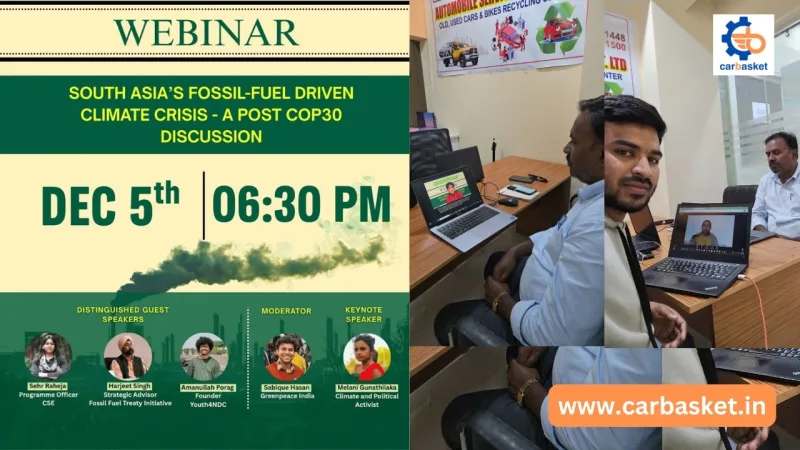
On December 5th, our team at CarBasket had the opportunity to attend the virtual webinar titled “South Asia’s Fossil-Fuel Driven Climate Crisis – A Post COP30 Discussion.”
The event brought together renowned climate experts, policy strategists, activists, and youth leaders to dissect the outcomes of COP30 and chart the path forward for climate justice across South Asia.
The session was highly insightful, especially with Sabique Hasan from Greenpeace India acting as the Moderator, guiding the conversation with clarity and deep contextual understanding.
Below is our detailed blog coverage, capturing key takeaways, speaker insights, and what this means for climate-responsible industries like CarBasket, particularly those involved in vehicle scrapping, recycling, and sustainable mobility transitions.
Why South Asia Faces a Fossil-Fuel Emergency
South Asia — home to nearly 2 billion people — is one of the world’s largest fossil-fuel consuming regions, yet also one of the least equipped to handle climate disasters.
Some challenges outlined during the webinar included:
- Rapid industrialisation without clean-energy frameworks
- High dependence on coal, diesel, and petrol
- Transportation sector’s growing emissions
- Rising frequency of extreme heat events
- Air pollution that exceeds WHO limits in major cities
- Slow transition to clean mobility and recycling practices
For industries like ours at CarBasket, which advocates sustainable vehicle scrapping, end-of-life vehicle recycling, and carbon-reduction pathways, discussions like this directly connect to our mission.
🎙️ Key Speakers & Their Contributions
1️⃣ Sehr Raheja – Programme Officer, CSE
Sehr highlighted the urgent need for policy-driven shifts.
She emphasised:
- Government accountability for fossil-fuel reductions
- Strengthening community-led climate programs
- Cleaner urban transportation planning
- Waste, recycling, and circular economy alignment with climate targets
2️⃣ Harjeet Singh – Strategic Advisor, Fossil Fuel Treaty Initiative
Harjeet Singh provided a powerful global perspective.
His core message:
“Without a global treaty to phase out fossil fuels, climate justice will remain incomplete.”
He explained how the Fossil Fuel Non-Proliferation Treaty could redefine global energy systems, and why South Asian nations must support it.
3️⃣ Amanullah Porag – Founder, Youth4NDC
Representing youth climate voices, he stressed:
- The growing climate anxiety among young people
- Importance of youth-led environmental movements
- Accountability in Nationally Determined Contributions (NDCs)
- Digital activism and community-led awareness
4️⃣ Keynote Speaker: Melani Gunathilaka – Climate & Political Activist
Melani delivered a powerful keynote connecting climate injustice, displacement, gender impact, and fossil-fuel politics across South Asia.
Her speech focused on:
- Climate migration
- Vulnerable coastal and rural communities
- Gender-differentiated effects of climate shocks
- Political decisions delaying climate solutions
🟡 Moderator: Sabique Hasan – Greenpeace India
A special mention is deserved for Sabique Hasan, who skillfully moderated the session. His expertise and engaging style helped the discussion flow meaningfully across:
- Policy outcomes of COP30
- The climate burden on India, Bangladesh, Sri Lanka, Nepal, and Pakistan
- The fossil-fuel lobby’s influence
- Climate justice obligations
- Community-first solutions
CarBasket acknowledges his crucial role in facilitating a rich, multi-angle discussion.
🔥 Key Learnings From the COP30 Post-Discussion
1. COP30 Signals a Turning Point — But South Asia Must Move Faster
While COP30 emphasized stronger climate action timelines, South Asian implementation remains slow due to:
- Coal dependency
- Economic pressure
- Inadequate renewable infrastructure
- Slow EV adoption and vehicle retirement policies
2. Fossil-Fuel Reduction Is Unavoidable
Experts agreed that coal and oil must be phased down urgently.
This includes the transition to:
- Renewable energy (solar, wind, green hydrogen)
- Electric mobility
- Sustainable vehicle recycling and scrapping
This directly aligns with CarBasket’s mission of safe scrapping and promoting environmentally-friendly automotive practices.
3. Transport Emissions Are Rising Rapidly
South Asia’s vehicle population has exploded in the last decade.
Issues highlighted:
- Outdated vehicles remaining in use
- Poor vehicle emission standards
- Lack of proper end-of-life vehicle recycling
This is where organisations like CarBasket play a pivotal role by enabling eco-friendly vehicle scrapping, reducing fossil-fuel pollution, and supporting circular mobility.
4. Climate Justice Must Be Community-Centric
Speakers stressed justice for:
- Fisherfolk
- Farmers
- Urban slum communities
- Women and children
- Climate migrants
- Informal workers
Climate policies must be designed to uplift vulnerable groups rather than burden them.
5. Youth and Private Organisations Will Shape the Next Decade
Young activists, startups, sustainability-driven companies, and recyclers like CarBasket contribute to:
- Grassroots awareness
- Emission-reduction efforts
- Circular economy
- Responsible consumption
This collective approach can accelerate South Asia’s climate transition.
🌿 How Events Like This Influence CarBasket’s Climate Mission
Being involved in the automobile recycling space, CarBasket strongly resonates with the discussions from the webinar.
CarBasket's commitment includes:
- Promoting green vehicle scrapping solutions
- Reducing fossil-fuel pollution through end-of-life vehicle (ELV) management
- Encouraging adoption of cleaner and safer mobility
- Supporting national goals aligned with COP30, Net Zero, and NDC frameworks
- Strengthening India’s circular economy in the automotive sector
We believe climate action is not just a government responsibility — private-sector participation is essential, especially in industries linked to transportation and waste management.
🌏 Why This Discussion Matters for India and South Asia
The webinar clearly established that if fossil-fuel dependency continues, South Asia may face:
- Higher climate disasters
- Water scarcity
- Food system disruption
- Air quality emergencies
- Economic instability
- Increased migration
But with stronger climate policies, renewable adoption, fossil-fuel treaty support, recycling progress, and public-private partnerships, a sustainable future is achievable.
Conclusion: A Call for Collective Climate Responsibility
CarBasket is proud to have attended this meaningful webinar and stands aligned with the principles shared by the distinguished speakers.
The journey toward climate justice is collective — and South Asia must act today.
From governments to corporations, activists to citizens, recyclers to innovators, everyone has a role in reducing fossil-fuel dependence.
As a company rooted in sustainability, CarBasket remains committed to contributing to a cleaner, safer, and climate-resilient future.