Buying a used car can feel like a smart financial decision. On paper, you save ₹2–5 lakh compared to a new vehicle, avoid depreciation, and get a “value-for-money” deal.
But in reality, thousands of Indian buyers lose money every year not at the time of purchase—but months later, when hidden problems surface.
Most buyers focus on:
- Price
- Exterior shine
- Fancy accessories
- Dealer promises
Smart buyers check what sellers hope you never verify.
This guide explains how to inspect a second-hand car in India the right way, the most common scams, the legal provisions under Indian law, and what to do when a car fails inspection—including when scrapping is the smartest decision with Carbasket.
Why Used Car Buying Is Risky in India (The Reality)
India has:
- Over 5 crore used car transactions annually
- A largely unorganised resale market
- Weak enforcement on odometer fraud and accident disclosure
As a result:
- Accident cars are sold as “non-accidental”
- Odometers are rolled back
- Flood and insurance-total-loss vehicles re-enter the market
- Buyers inherit future repair bills worth lakhs
🔍 The 3 Checks That Decide Whether You Save or Lose Money
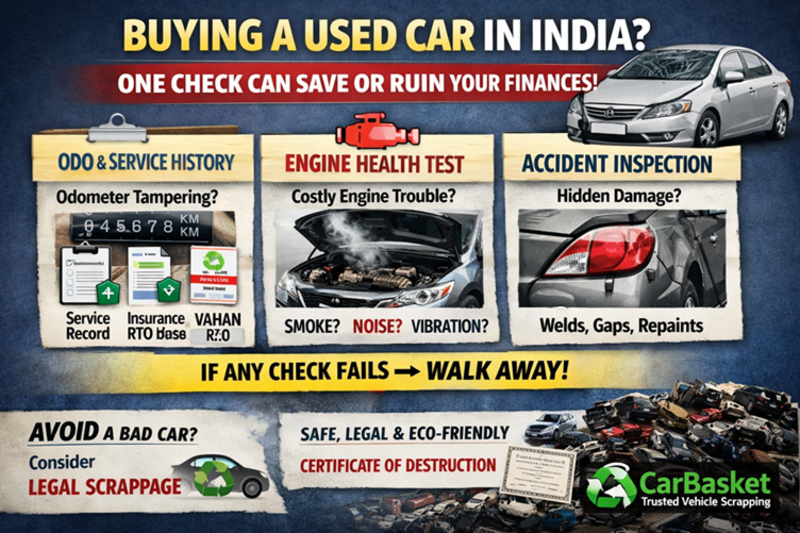
1️⃣ Odometer & Service History Check (Most Common Scam)
❌ The Myth
“If the odometer shows low kilometres, the car is safe.”
✅ The Reality
Odometer tampering is one of the most common used car scams in India, especially in:
- Diesel cars
- Commercially used vehicles
- Inter-state registered cars
A 1.5 lakh km car can easily be rolled back to 60,000 km.
What Smart Buyers Do
Always cross-check:
- Service records (authorised workshop preferred)
- Insurance claim history
- RTO data (VAHAN / mParivahan)
- Emission test records
- Wear signs (pedals, steering, seat bolsters)
📌 If numbers don’t match, walk away.
2️⃣ Engine Health Test (The Most Expensive Mistake)
Why This Matters
Engine repairs are the costliest surprise in used cars:
- Minor overhaul: ₹50,000+
- Full rebuild or replacement: ₹1–3 lakh
- Turbo / injector failures (diesel): ₹80,000–₹1.5 lakh
How to Check Engine Health
Start the engine cold and observe:
- Smooth idle (no shaking)
- No loud knocking or metallic noise
- No burning oil or diesel smell
- No blue or white smoke from exhaust
Test drive indicators:
- Delayed acceleration
- Gear lag
- Engine overheating
- Excessive vibrations
❗ Many buyers ignore early symptoms and regret it later.
3️⃣ Accident & Structural Inspection (Safety Comes First)
Why Accident Cars Are Dangerous
Even well-repaired accident vehicles:
- Lose structural strength
- Offer lower fuel efficiency
- Have compromised safety during future crashes
- Get lower resale value
Where to Inspect (Not Just the Body)
Check:
- Door frames & pillars
- Chassis rails
- Boot floor
- Engine bay corners
- Panel gaps (uneven gaps = red flag)
- Weld marks or repaint patches
Flood-damaged and accident-total vehicles often circulate silently in the resale market.
📌 If structure is compromised, no discount makes it safe.
🚨 The Golden Rule of Used Car Buying
If history, engine, or accident check fails — WALK AWAY.
There are always more cars.
There is no undo button for a bad purchase.
Legal Provisions You Should Know (India)
Motor Vehicles Act, 1988 (Key Points)
- Selling a vehicle with suppressed material facts can invite legal consequences
- Odometer tampering is a punishable offence
- Insurance claim suppression is misrepresentation
- RC transfer delays keep liability with the previous owner
Vehicle Scrappage Policy (2021)
- Unsafe, old, or failed-fitness vehicles should be legally scrapped
- ELVs (End-of-Life Vehicles) must not be resold illegally
- Fitness failure = vehicle should exit the road ecosystem
Myths vs Facts About Used Cars
❌ Myth 1: “Dealer guarantee means safe car”
✅ Fact: Dealer guarantees are rarely enforceable legally
❌ Myth 2: “Accident cars are okay if repaired”
✅ Fact: Structural damage permanently reduces safety
❌ Myth 3: “Low price justifies risk”
✅ Fact: Repairs often exceed the discount
❌ Myth 4: “Old cars are always cheaper to own”
✅ Fact: Maintenance + fuel + compliance can cost more than EMI on a new car
When NOT Buying Is the Smartest Decision
Many buyers come to a realisation:
- The car has hidden damage
- RC or ownership history is messy
- Fitness renewal is expensive
- Engine health is poor
In such cases, scrapping is safer than resale.
How Carbasket Helps Buyers Avoid Costly Mistakes
At Carbasket, we see the other side of the used car market:
- Vehicles rejected by smart buyers
- Accident and flood-damaged cars
- Mechanically unsafe vehicles
- Cars dealers couldn’t resell
What Carbasket Does
- Evaluates vehicles only on real scrap value
- Offers higher transparent pricing
- Provides free pickup across India
- Ensures legal scrappage & RC deregistration
- Issues Certificate of Destruction (CoD)
Instead of selling a risky car to another unsuspecting buyer, Carbasket ensures it exits the system responsibly.
Frequently Asked Questions (FAQs)
Is it safe to buy a second-hand car in India?
Yes—only if full history, engine health, and accident checks pass.
How can I detect odometer fraud?
Cross-check service records, insurance data, and physical wear indicators.
Should I buy an accident-repaired car at a discount?
Not recommended. Structural integrity and safety are permanently affected.
What if the used car fails inspection?
Walk away. If you already own it, consider legal scrappage with Carbasket.
Is scrapping better than selling a bad car?
Yes. It avoids legal, ethical, and financial risks.
Final Takeaway
A used car can be a smart purchase—or a financial trap.
The difference is not luck.
It’s inspection.
If something feels off:
- Don’t negotiate
- Don’t compromise
- Don’t emotional-buy
Walk away. Save your money. Protect your future.
And when a vehicle no longer deserves to be on the road—
Scrap it responsibly with Carbasket. 🚗♻️