1) What is India’s V2V Policy?
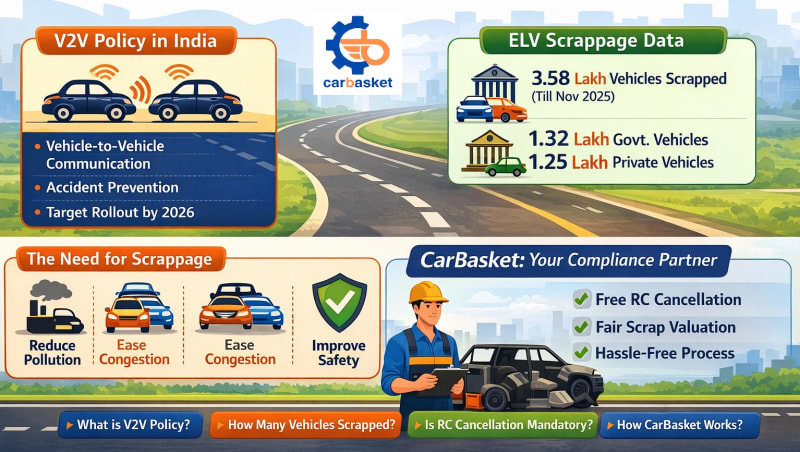
V2V (Vehicle-to-Vehicle) communication is a road-safety technology where vehicles exchange safety messages (speed, location, direction, braking alerts) so drivers and onboard systems get early warnings before they visually detect a hazard - especially on curves, blind spots, fog, or sudden traffic slowdowns.
What’s happening in India
Recent reporting and minister statements indicate India is planning a nationwide V2V rollout by end of 2026, with the intent to reduce accidents and strengthen road safety systems (often discussed alongside ADAS).
Why V2V matters
India’s traffic environment is complex:
- mixed road users (2W/3W/4W, buses, pedestrians)
- unpredictable merges and hard braking
- high congestion and narrow corridors
V2V aims to reduce collisions by sharing hazard information instantly between vehicles.
Important clarity: V2V is primarily a safety technology. It can indirectly reduce congestion from crashes, but it does not automatically reduce emissions unless paired with fleet modernisation and removal of high-emission ELVs (End-of-Life Vehicles).
India will mandate vehicle-to-vehicle (V2V) communication in all new cars to improve road safety.
📡 A dedicated 30 MHz spectrum will allow instant, low-latency sharing of data like speed, braking, and road hazards without relying on mobile networks.
🚗 The initiative aims to reduce crashes on highways and intersections while supporting ADAS, smart traffic systems, and future autonomous vehicles.
2) Why V2V and Vehicle Scrappage belong in the same “clean + safe mobility” story
Think of India’s mobility problems as two linked layers:
Layer A - Safety (crashes, fatalities)
V2V helps by warning drivers/vehicles earlier.
Layer B - Fleet quality (age, emissions, breakdowns)
Old/unfit vehicles:
- pollute more per km
- break down more often → block lanes → worsen traffic
- are often non-compliant with evolving fitness and safety expectations
So the strongest city impact comes from a combined approach:
- Prevent crashes (V2V + safer roads + enforcement), and
- Remove unfit vehicles (scrappage + compliance closure + recycling).
3) How big is the “old / ELV universe” in India?
India’s Voluntary Vehicle-Fleet Modernization Programme (VVMP / Vehicle Scrappage Policy) was framed around a large ageing-vehicle base, commonly cited as:
- 51 lakh LMVs older than 20 years
- 34 lakh LMVs older than 15 years
- 17 lakh M&HCVs older than 15 years without valid fitness
That’s a direct “at-risk/eligible” universe of roughly 1.02 crore vehicles.
4) How many vehicles are actually being scrapped?
To avoid guesswork, use the government’s published counts from PIB / Parliament answers.
A) Scrapped via registered facilities (RVSFs) – cumulative
- 96,980 vehicles scrapped at RVSFs as on 15.07.2024.
- MoRTH year-end review states cumulatively 3.58 lakh vehicles scrapped till November 2025 and mentions scale-up of RVSFs/ATS.
B) Split: Government vs Private vehicles
A Lok Sabha answer (July 2025) reports (as per info available):
- 1,32,612 Government vehicles scrapped
- 1,25,721 Private vehicles scrapped
- at RVSFs.
What this tells the market:
The system is moving from “policy” to “execution” - RVSF capacity is expanding and scrappage totals are accelerating.
C) RVSF network growth (ecosystem readiness)
MoRTH has stated 84 RVSFs operational as on January 2025 (and later updates show further scale-up).
5) Vehicle density: why “old vehicles” hurt more in high-density corridors
India’s biggest urban pain point isn’t just number of vehicles - it’s vehicles competing for limited road length.
A widely cited metro example:
- Kolkata reported about 2,448 vehicles per km of road, highlighting how congestion multiplies travel time and emissions.
Why density amplifies ELV impact:
- Idling and stop-go driving increases emissions
- A single breakdown blocks lanes and creates long queues
- Older vehicles often have higher smoke events under load (AC, flyovers, traffic jams)
So, in dense cities, scrappage becomes a public health + traffic efficiency tool, not just recycling.
6) MVI Act provisions you should mention (scrappage + closure)
Section 55 — Cancellation of registration (critical after scrapping)
Motor Vehicles Act, 1988 provides for cancellation of registration when a motor vehicle is destroyed or permanently incapable of use; owners must report and forward the RC to the registering authority within the required timeline.
Section 56 - Fitness certificate (especially for transport vehicles)
The Act also covers fitness certification requirements for transport vehicles—fitness compliance is a central lever in identifying unfit vehicles for scrappage.
Practical takeaway for owners:
Scrapping isn’t only “selling metal.” The real closure is legal closure (RC cancellation and proper documentation trail).
7) Myths vs Facts
Myth 1: “V2V will solve road problems, so scrappage isn’t needed.”
Fact: V2V improves safety. Pollution + reliability issues still require removal of unfit vehicles.
Myth 2: “My vehicle is old, but it runs - so I can ignore compliance.”
Fact: Fitness and registration rules can tighten over time; non-compliance increases legal and insurance risk.
Myth 3: “RC cancellation happens automatically after I sell to a scrap dealer.”
Fact: Owners must ensure proper cancellation workflow under the law (Section 55) with correct documentation.
Myth 4: “Scrappage value is always low.”
Fact: The real value = scrap payout + risk elimination + legal proof. Informal routes may pay today but create liability tomorrow.
8) How Carbasket fits: India’s compliance-first scrappage platform
Carbasket positions itself as the execution + trust layer between:
- vehicle owners (private + fleets + institutions),
- RTO compliance requirements,
- and the authorised scrappage ecosystem.
What Carbasket does (platform promises)
- Eligibility guidance (age, fitness risk, state nuances)
- Transparent valuation logic (material recovery + category + condition)
- Doorstep coordination (pickup & handover support)
- Compliance-first pathway (helping owners avoid misuse risk)
- Closure guidance (RC cancellation steps aligned with MVI Act principles)
9) “Private vehicle data input” module (high-conversion, AEO-ready)
Check Scrappage Eligibility - India
- Vehicle type: 2W / 4W / LCV / HCV
- Registration state + RTO code
- Make / model
- Year of manufacture
- Fuel type
- RC available? (Yes/No)
- Hypothecation? (Yes/No)
- City + PIN
- Upload photos (front/back/left/right/engine bay)
This becomes a structured ELV demand pipeline even when city-wise private scrappage numbers are not publicly available in real time.
FAQs
Q1. What is V2V policy in India?
V2V is vehicle-to-vehicle communication where vehicles exchange safety messages to warn each other about hazards; India is reported to be targeting rollout by end of 2026.
Q2. How many vehicles have been scrapped at registered scrappage facilities (RVSFs) in India?
Government releases report 96,980 vehicles scrapped as on 15.07.2024, and 3.58 lakh scrapped cumulatively till Nov 2025.
Q3. Are both government and private vehicles being scrapped at RVSFs?
Yes. A Lok Sabha reply (July 2025) reports 1,32,612 government and 1,25,721 private vehicles scrapped at RVSFs (as per info available).
Q4. What does the Motor Vehicles Act say about scrapped vehicles?
Section 55 covers cancellation of registration when a vehicle is destroyed/permanently incapable of use, requiring reporting and forwarding the RC to the registering authority.
Q5. Why is vehicle density important in scrappage discussions?
High vehicle density worsens congestion and emissions; e.g., Kolkata has been reported at ~2,448 vehicles per km of road, showing how quickly cities saturate.