One of the most common confusions among vehicle owners in India is this:
“Is vehicle de-registration the same as RC cancellation?”
The short answer is:
They are closely linked, but they are not exactly the same in how people assume them to be.
This confusion leads to:
- Vehicles being scrapped but still legally active
- Owners receiving challans years later
- Criminal or misuse liability
- Incomplete closure under Motor Vehicle rules
Let’s break this down clearly, legally, and practically, based on MVI and RTO processes.
What Is RC (Registration Certificate) Cancellation?
RC cancellation refers to the official invalidation of a vehicle’s Registration Certificate issued by the RTO.
Once RC is cancelled:
- The vehicle is no longer authorised to operate
- The registration number becomes invalid
- Ownership responsibilities end
- The vehicle cannot be sold, transferred, or used again
RC cancellation is the document-level action.
What Is Vehicle De-Registration?
Vehicle de-registration is the removal of the vehicle entry from the VAHAN / RTO database.
Once de-registered:
- The vehicle legally ceases to exist on Indian roads
- It is permanently removed from government records
- No future transaction is possible
De-registration is the system-level action.
Are Vehicle De-Registration and RC Cancellation the Same?
✅ Practical Reality (Ground Truth)
In most real-world cases, RC cancellation leads to de-registration.
That’s why people think they are the same.
But legally and technically:
- RC cancellation is the process
- De-registration is the final outcome
👉 You cannot de-register a vehicle without cancelling the RC
👉 Cancelling RC is meaningless if de-registration is not completed in records
Why This Confusion Exists (Common Myths)
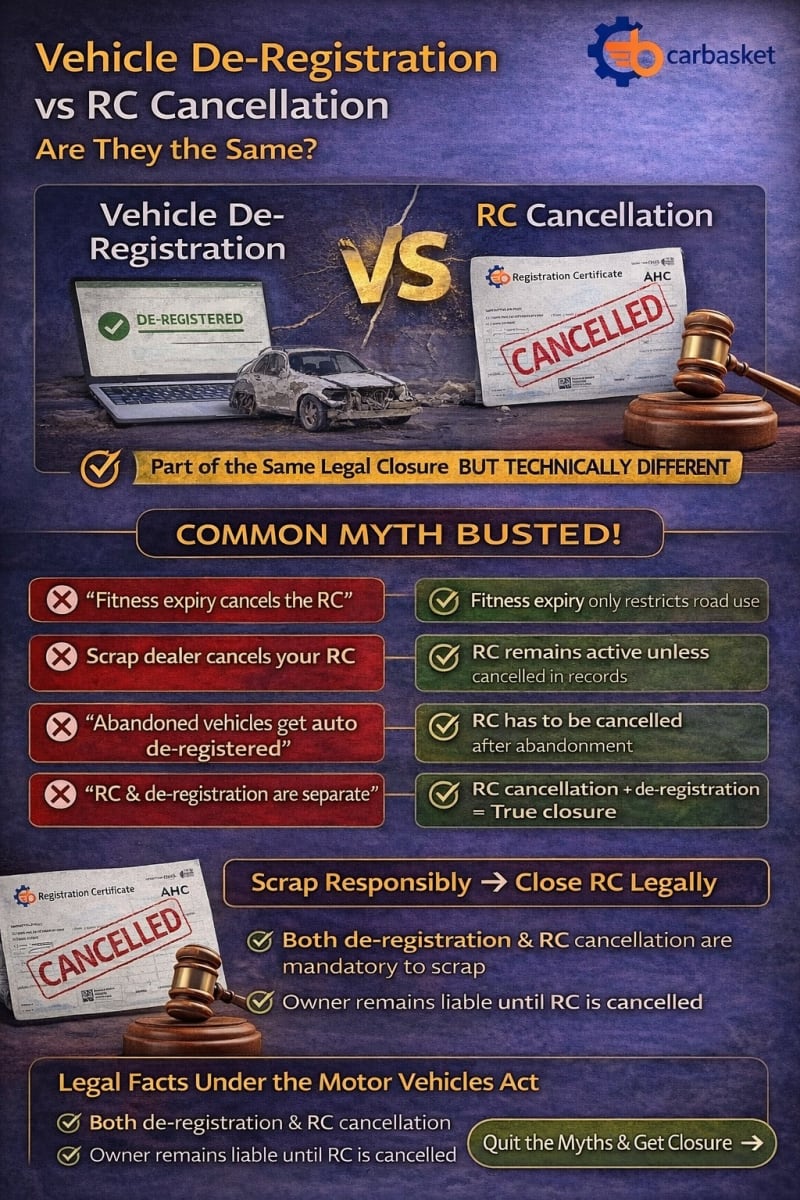
❌ Myth 1: “Scrapping automatically cancels RC”
Truth:
Only authorised, documented scrapping can trigger RC cancellation. Informal scrapping does nothing legally.
❌ Myth 2: “Fitness expiry means RC is cancelled”
Truth:
Fitness expiry only restricts road use.
The RC remains active unless cancelled.
❌ Myth 3: “Abandoned vehicles get auto de-registered”
Truth:
Abandonment does not cancel RC or de-register the vehicle.
❌ Myth 4: “RC cancellation and de-registration are two different applications”
Truth:
They are part of one legal closure process, not separate choices.
How MVI (Motor Vehicle Inspector) Views This
From an MVI / RTO enforcement perspective:
- A vehicle is considered active until RC is cancelled
- RC cancellation must be recorded in VAHAN
- De-registration confirms the vehicle is permanently removed
- Scrapping without RC cancellation is non-compliant
For MVIs, paper closure is as important as physical disposal.
When RC Cancellation & De-Registration Are Mandatory
Both are mandatory when:
- Vehicle is scrapped (end-of-life)
- Vehicle is declared total loss
- Vehicle is permanently exported
- Vehicle is condemned or surrendered
- Vehicle fails fitness permanently
Situations Where People Think It’s Done (But It’s Not)
Situation RC Cancelled? De-Registered?
Vehicle parked unused ❌ No ❌ No
Vehicle sold to scrap dealer ❌ No ❌ No
Fitness expired ❌ No ❌ No
Accident vehicle left idle ❌ No ❌ No
Informal dismantling ❌ No ❌ No
👉 Only formal processes close records
Legal Basis Under Motor Vehicles Act
Under:
- Motor Vehicles Act, 1988
- Central Motor Vehicle Rules (CMVR)
- National Vehicle Scrappage Policy
Key principles:
- Vehicle exists legally until RC is cancelled
- De-registration is mandatory for permanent removal
- Owner remains liable until records are closed
- Environmental and safety compliance is enforced through record control
How Carbasket Ensures Proper Legal Closure
Carbasket does not treat scrapping as just vehicle pickup.
Carbasket’s compliance-first approach includes:
- Guiding owners on RC cancellation
- Ensuring scrapping follows recognised processes
- Preventing illegal reuse of chassis or RC
- Supporting proper record closure
- Reducing future legal and financial risk
👉 The focus is on legal peace of mind, not just scrap value
Why This Matters for Vehicle Owners
If RC is not cancelled:
- Traffic challans may appear years later
- Vehicle may be misused illegally
- Ownership disputes can arise
- Insurance and legal complications continue
RC cancellation + de-registration = true closure
FAQs - De-Registration vs RC Cancellation
Are RC cancellation and de-registration the same?
They are part of the same legal closure process, but RC cancellation triggers de-registration in records.
Can RC be cancelled without scrapping?
Only in limited cases like export or total loss with valid documentation.
Does Carbasket cancel RC automatically?
Carbasket guides owners and ensures the scrapping process aligns with RC cancellation requirements.
What if I scrapped my vehicle years ago without RC cancellation?
You may still be legally responsible. It’s advisable to regularise records immediately.
Is RC cancellation mandatory under MVI rules?
Yes, for permanent removal of a vehicle from use.